Typically when I am trying products for stain removals, I like to have tested them a lot. I want a metric fuck ton of data to be able to provide for a product before I even think about making a tutorial about it. I need to know how it behaves. What it’s good at, what it might wreck, what it does nothing to. When I feel like I have that data, or a good feel and understanding for the product’s chemistry and how it works, that’s when I start drafting.
You know what I love? I love living in Chicagoland. If you wander here with an open mind, a respectful heart, and a healthy curiosity for the unknown, you can find answers. I was sold the same thing that a lot of kids my age were sold growing up: that the United States is a melting pot. Time, age, and reality have brought me to realize that it’s a fuck of a lot more complicated than that. But I think that if I grew up in the community I’m living in right now, I would still believe it.
So there I was, fucking around in public like I usually do, and I got to conversing with this lovely lady from India. She runs a cleaner service nearby, and our conversation revealed to me that she, too, is a sucker for fantastic textiles. Dyeing, sewing, textures, and of course maintenance. She gave me this product, which she uses for stain removal on Saree, to try:
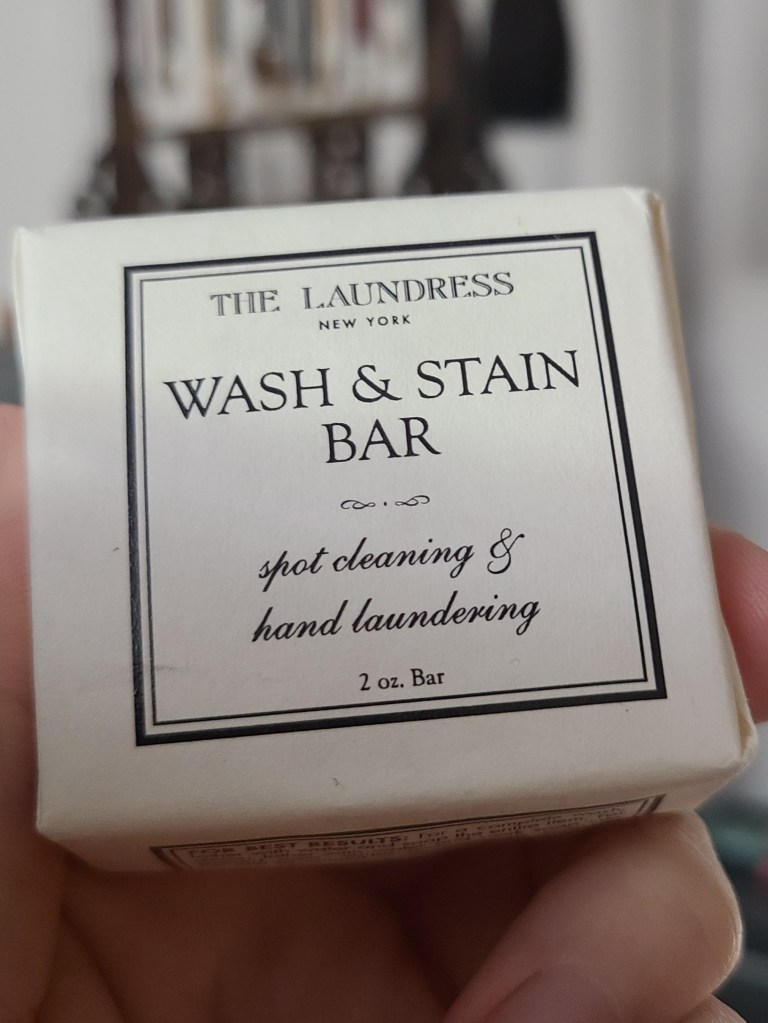
I want you to know right away, before I get into shit else in this entry, that after my experience with this bar, I have ordered a crap ton more things from The Laundress to test.
My reaction to the power this little soapy motherfucker packs:

I want every one of you to believe that I do all of this in full combat gear. With laser eyes. And a gun. What? I did say I live in Chicago.
Moving on.
As with most stain removers, detergents, solvents, and whatever-the-fuck-else I slather onto vintage silk for science, the first thing I did was read the instructions. The second thing that tends to happen there is completely disregarding the instructions because fuck the police they simply won’t work in my situation. In this context, it’s because a lot of these things want you to put your stained garment in the washing machine and let’s be real fucking clear, I AM NOT GOING TO BE PUTTING ANY KIMONOS IN THE WASHING MACHINE, THANK YOU. And neither should you. I don’t give a damn if your washer has an excellent delicates cycle, and don’t you fucking @ me with your mesh laundry bag. Step the fuck away from the Whirlpool, we are not doing that. I will fight you.
So I whip out my lab rat and dick around with the product a bit to see how it behaves. Some solvents just evaporate. I actually love taking up non-colorfast dye bleed with acetone and q-tips because acetone doesn’t have to be rinsed out. But this is basically a soap, and soap has to be rinsed out properly or it’s going to cause you more headaches.
You know what happens if you don’t rinse away soap? That spot is about to get a fuck of a lot dirtier than you had dealt with to begin with, so let’s not play the shortcut game. Rinse ya damn soaps.
I had some advice from the lovely lady who gave me this as far as how to employ it for items that can’t be fully submerged, and I started there. It’s worth noting that neither of us really follow the instructions on the label, and there’s a good reason for that. The primary vehicle of this stain remover is borax, and it says that right on the label. Borax isn’t hardcore dangerous like chlorine bleach or straight up ammonia, but it if employed incorrectly it could be harsh. Remember, this shit isn’t magic. It’s actually chemistry! Silk prefers acidic things over alkaline things–you can Google that if you want to hear the whole reasoning for it, because I don’t have it in me to turn this into a chemistry lesson. Borax is alkaline, but not severely so.
Does that mean you can’t use it at all?
Weeeeelllllll…By itself? Probably not! In this bar of soap? I don’t recommend you mash it right into the fabric, either.
However! When you use it as I tell you to in this tutorial, it’s safe. You wanna know how I know that? Because I got this stuff real frothy and into some water, which is how I apply it to a stain, and I literally just fucking pH tested it mygoddamnself. You can laugh all you want, but I used the API Master Test kit, because I keep fish, and I love my fish so you bet your sweet ass I keep track of their water parameters.

How does this soap measure up? The pH tests measures at somewhere between 7 and 8. That means that in this solution, it’s close enough to neutral.
So that’s why things like context always matter, kids. Don’t dump borax on your kimono, but you can totally use this bar of soap safely.
And with all of that out of the way, let us begin. For this exercise in whimsical fuckery, I’ll be removing some darkened stains on this lovely antique I picked up awhile ago.

You will need:
-This bar of soap.
-1/4 cup of water in a bowl or glass or some shit–just don’t use plastic.
-A squirt bottle filled with room temperature purified or distilled water.
-A soft scrub brush–I’ll be using a watercolor paintbrush.
-White towels or paper towels–a shit ton of them.
First, make sure you’re testing inside the seam allowance for colorfastness before you begin. Then select your stain. I’ll be working on this piece of shit blob of god knows what on the sleeve.

The next thing we need to do is pick the seam closest to the stain so that we can get a towel or bunch of paper towels between the shell and the lining. If you aren’t confident with opening and closing a seam for this purpose, I got you, bruh. And as you can see here, I have a dummy thicc wad of paper towels tucked in here. Behold:

Now open up your soap, and squirt some water onto the bar of soap. I didn’t take a picture of that because I suck. But you’re going to be using your brush to make a bit of a froth out of it. That little container of a quarter cup of water is about to get real goddamn sudsy. Now there’s no real way to measure this, and I don’t think I ever used a real measurement. I got the water nice and cloudy with soap. Alternatively, you can also just wet the stain, and then get your brush a bit sudsy and then just rub the suds onto the stain. I have done this both ways, and they both work.
When you start soaping up your stain, you want to do some scrubbing. Don’t go insane, just work it into a good lather using medium pressure. Be nice to your silk. Remember that silk is more fragile wet than it is dry.

This is the part where I fuck off for a good twenty minutes or so. I haven’t let this mixture sit for more than a half hour at a time, because I don’t find it to be any more effective that way. When time is up, come back and get your brush nice and wet to work it all into a lather again. Then we’re going to spray it with water and press it with your towels or paper towels. This is the rinse cycle–do not be nice with your pressing, and you want to repeat this process until you’re not seeing anymore bubbles. Press hard. No mercy.
Oh by the way, you know how I harp on putting cloth between layers? This is why:

See that shit? Okay, so if it’s a very light color like that coming off, don’t panic. Blues, greens, and reds have a tendency to bleed off a little bit of color without fading on the fabric. Just a little bit of color transfer isn’t anything to freak out about. This is a good time to be clear about something: if you tested for colorfastness and got this on your towel, and then decided you couldn’t use that method, you did it wrong. That’s on me, I wasn’t clear. The only thing you need to give two flying fucks about is what the fabric looks like when it’s dry. If it looks normal, then you test it again. If it stands up to two treatments without fading on the fabric, no matter what comes up on your towel, you’re golden.
Anyway, then go fuck off for a bit while it dries. I like to towel press it until I’m not soaking up any moisture anymore, then just let it air dry. No heat! If you apply heat to dry it, and you didn’t get the whole stain out, you just fucking heat set that stain. Good luck with that shit.

It’s dry now, and while not perfect, you have to get right on top of it to see where the stains were.
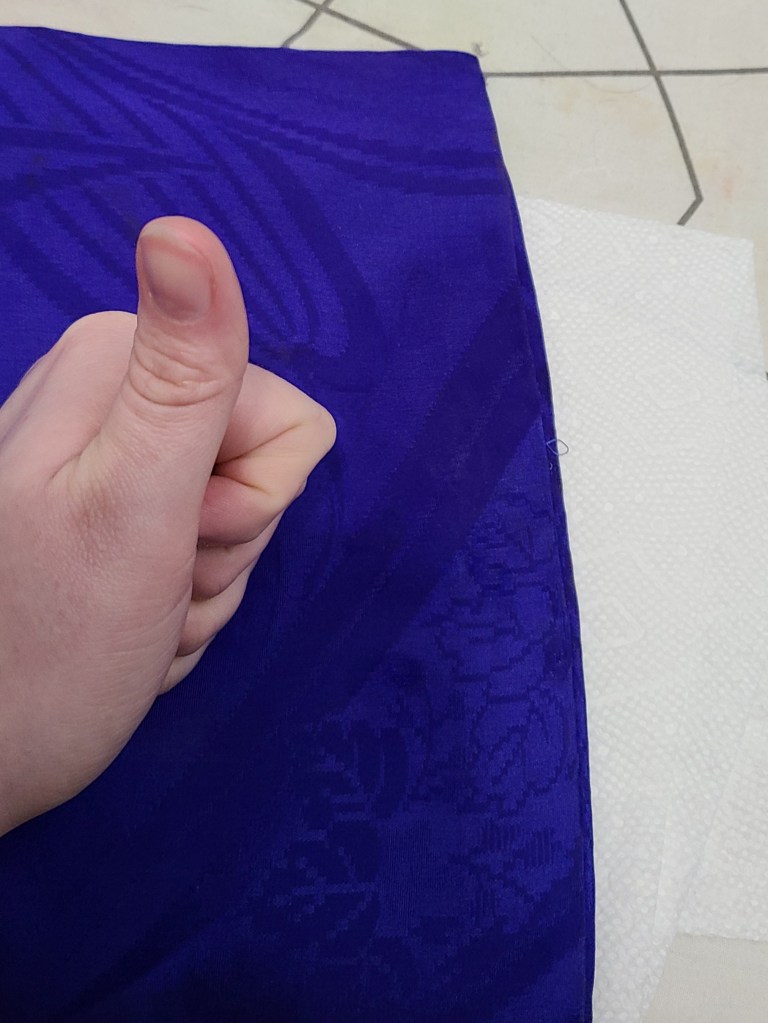
That’s the good shit right there. Some of you have been exercising the methods I try here, and you’ve been able to experience the “moment the stain came out” high. I’ve never done drugs but I’m going to confidently say that it’s better than crack.
Crack is probably cheaper than this hobby. But having to change my blog name to Crack & Bones just doesn’t have the same ring to it.
You’re next, chucklefuck:

Some notes on this method: it’s fantastic with sweat stains, food stains, surface grime, dirt, mud, grass stains, and grease stains. It is okay-ish at blood and some kinds of ink. It does not remove dye bleed, and it’s really hit and miss with mold/mildew stains. I don’t bother with this for water stains, the vinegar method does a better job.
Questions? Concerns? Need to move a body? Leave a comment or send a message! We’ll figure this shit out together! FRIEENDSHIIP.
BYE.

 Silk & Bones
I am obsessed with your blog. I just purchased several silk pieces second hand and got a good deal because they have stains. Are there alternatives to the laundress soap that would work?
LikeLiked by 1 person
I recommend matching the type of cleaner to the type of stain with the fabric in mind.
Foxing, for example, which is small yellow spots, can usually be murdered with acetic acid–distilled white vinegar. No soaps needed.
The big question is what kinds of stains on what kinds of garments are we trying to annihilate? I have a few different stain removal methods on the tutorial page, but I have more tricks up my sleeves for things that don’t have tutorials yet. 💜
LikeLike
so…I am not sure yet what the stains are from because I haven’t received the garments, but I’ll follow up once I get them. From the pictures it looks like coffee and food and dirt, but hard to tell. The pieces are both from the brand everlane, one is a dress and one is a button up shirt. My hope is that I can remove the stains enough that they aren’t noticeable. Plan B is dyeing or painting.
LikeLiked by 1 person
For dyeing, remember that dye is transparent. If you dye over a stain, the stain will show through of it isn’t dissolved in the dyebath. Think of dyes like watercolors in this way.
But! If we’re going down the dye route with the button up, reductive bleaching is an option! Let me know what’s up when they arrive. We’ll see what needs to be done!
LikeLike
I like your blog but why do you have to say fuck and shit all the time? It totally distracts and alienates from the subject matter. Also, if you are talking about kimono and other textile, many second language speakers will be alienated by this. Essentially it is unnecessary. Stick to the facts. I am a textile lover but was so distracted by your wording to get the message. If you are a blogger, communicate! Clean up you act ( pun intended). Please! 🙏 🙏🙏🙏🙏
LikeLike
No.
My blog is free. Entirely. I don’t make any money on it at all. It is ad free, there’s nothing to buy, and I don’t do sponsorships. In fact, I pay EXTRA every year to keep it free.
So as you have come here to enjoy this tutorial that I’ve put up entirely for free in a format that doesn’t even advertise to you, I don’t think it’s even remotely fair for you to complain because you don’t like the way I talk.
I do this because it’s something I enjoy. And part of the process for me as a former computer repair tech is being gloriously obscene until the problem is solved. It’s fun for me. And the moment this stops being fun for me, I’m going to stop doing it.
So if you don’t like my language, leave. Bye. Get advice elsewhere. Nobody is forcing you to stay here.
I crossed 50k views the other day. I get daily emails asking for help. I think the message is coming through just fine.
Do not speak to me like this again. Telling me to clean up my act in a place where you get advice for free is disrespectful. This isn’t a business, this is my home. Don’t come into my house and tell me how to talk. Ever.
LikeLike
I just discovered your blog and I see light at the end of the tunnel! I bought some vintage Kimonos and Obis in Japan last year. They were from a second hand store that has all kind of household stuff as well, not just clothes. Anyway, I didn’t notice at the time, but they smell bad, like… REAL BAD, like a mixture of basement, mold and insecticides. So I hung them to air out on the balcony in the shade for a week, but it didn’t get better. I used to work with theatre costuming, we sprayed costumes that couldn’t be washed with alcohol to get rid of smells, so I did that. Since then, they’ve been hanging in my room on a clothes rack (for the past… 5 months), and it has gotten better but it’s not gone, when I directly sniff, it’s still so bad… Do you have any suggestion what to do? I actually washed some Haoris that were cotton, because I was so desperate, but it actually made the smell SO MUCH WORSE when they were wet, and even afterwards it wasn’t better… Most of the items have holes and bad stains, so I plan to take them apart and upcycle them, but I definitely want to make some tops or dresses with the beautiful silks, so it would be heartbreaking if I couldn’t wear them cause of the smell..
Secondly, I read that you call the tiny little yellow spots ‚foxing‘. So if you treat them with vinegar, do you wet the entire area or do a spot treatment? As I’ll be taking most of the Kimonos apart, could I make a vinegar-water bath and soak the fabric in there for a bit (if no color bleeding)?
Lastly, I don’t live in the US, do you know what’s in those magic soap bars? Perhaps I could find one with similar ingredients here. Have you experimented with Fairy Dishwashing soap? I read on other blogs that it works well, also for color bleeding…
Thank you so much for all the hard work and testing,best wishes,Anna
ps: i sent this comment before but idk if it’s awaiting moderation or didn’t go through, so here we go again. Also, just to avoid misunderstanding: I love kimono, and I have some that I’ll definitely keep the way they are because they’re just so gorgeous. I am mainly looking to give a second life to some more simple ones in bad shape….
LikeLiked by 1 person
Hey! To your PS, I actually screen every single comment for user privacy purposes. You would be absolutely SHOCKED how often people leave their personal contact information for me in regular comments. Because of that, I set them to manual approval. The last thing I need is people who don’t understand the system doxxing themselves. 😭
The big ingredient in those soap bars is borax.
There is a tutorial for odor control on the way!
LikeLike