We start with dinner and a movie, and we see how the night goes.
You’re welcome for that, I’m very funny. No really, though, this is actually a blog by popular demand. I wasn’t going to address it right away, but as of right now my restoration station and pretty much everything else is shut the fuck down because I’m dealing with a silverfish infestation.
Storytime:
A few months ago, we had a leak in roof. We rent this house, and of course per our rental agreement, we had to inform the management company so that they could hire a contractor to fix it. When they came down from the roof, I asked if the insulation in the attic was okay. The contractor stared at me like a dead fish, made a phone call, then said it should be fine. Later, there was another leak. Hail is fun, shit happens. It was repaired in a similar manner, and I asked again “Is the insulation in the attic okay? Is there moisture in the attic that needs to be dealt with?”
Again, I was met with an answer suggesting that it was handled.
Suddenly, my housemates started seeing silverfish in places we don’t usually see them. It’s not abnormal for us to see one or two every few months in say, a bathroom. We live near the wetlands, bugs happen. But they were in places like Sarah’s bedroom, and Ryan’s bedroom, and in the hall. Then suddenly I started seeing them in my bedroom. So I did the needful and investigated and guess the fuck what–we’ve got ourself a fucking silverfish infestation because the insulation in the attic was not fine.
Silverfish eat silk. And my awaiting restoration pieces were once upon a time in a place I considered secure because my closet is carpeted, dry, clean, and climate controlled. So I’ve been taking the time to reinspect every single piece, fold them, and seal them into totes while I deal with the infestation. We can’t just use bug bombs–I have birds. It will kill my birds. So this is going to be a war.
So that’s what I’ve been up to. And while I’m handling this and staging my totes in the dining room, I can talk about the tips and tricks I use to determine how old a kimono is. Because one thing people ask me to do a lot and I’m actually very good at is ballparking the age of a kimono.
So, Becky, how do you determine how old a kimono is?
Well I use my eyes. That sounds super sarcastic but it actually really isn’t. Antique kimono are visibly remarkably different than contemporary ones in many respects. You can see the differences in colors, textures, pattern execution, fabric thickness, techniques…all of these things are just right there screeching “LOOK AT ME!” presumably while also ripping their shirts off.
…what…
The key here is learning what it is that you’re looking at.
If I were to write you a step by step guide on how to date a kimono that didn’t involve wining and dining, it would begin with me making a ton of noises and freaking out over how to even fucking organize the damn thing deciding to break it into parts because of some good advice:
Go worship this person at Kimono_keisatsu, as their style is just 10/10 delightful.
And so we have that lovely “Part 1” up there, and that’s how we’re doing this. Today, we’re going over women’s antique kimono, excluding uchikake and stage items. I’m going to be focused on mostly dye techniques in this entry. Other items will be covered at later dates. It also says “at a glance,” and I mean it. Because in further entries, we’re going to talk about specifics. Like, what makes an antique kurohikifurisode versus a vintage one? And there’s going to be room to be very specific about shit in those entries. And with that out of the way, let’s get started.
For the sake of ease and shit, I’d like to state right here that I will refer to anything pre-WWII as “antique.” And basically, I refer to anything that was made before kimono production shut down temporarily in 1945 as pre-WWII. Now you know what the hell I’m talking about. So! If I were telling you how I date a kimono and you put a gun to my head and forced me to break it down into steps, and I wasn’t allowed to say “I use my eyes,” this is how I date a kimono at a glance:
Step 1: Identify the kimono type.
In short, what kind of kimono are we looking at? Is it a casual kimono like a komon, something in the middle like a tsukesage? Is it a furisode? Or are you staring at it like a goldfish that’s been tazed? That last question is important because, as I like to harp on like an evicted angel with a meth addiction, antique kimono don’t tend to give a single solitary fuck about contemporary formality standards. So if your kimono seems to break a bunch of rules, there’s a chance it’s older. I’ll touch on that briefly but they will get their own entry.
Step 2: Pick out the red flags.
But let’s look at the red flags. Literally. Does your kimono have a red lining anywhere that isn’t the hakkake (lower skirt lining)?
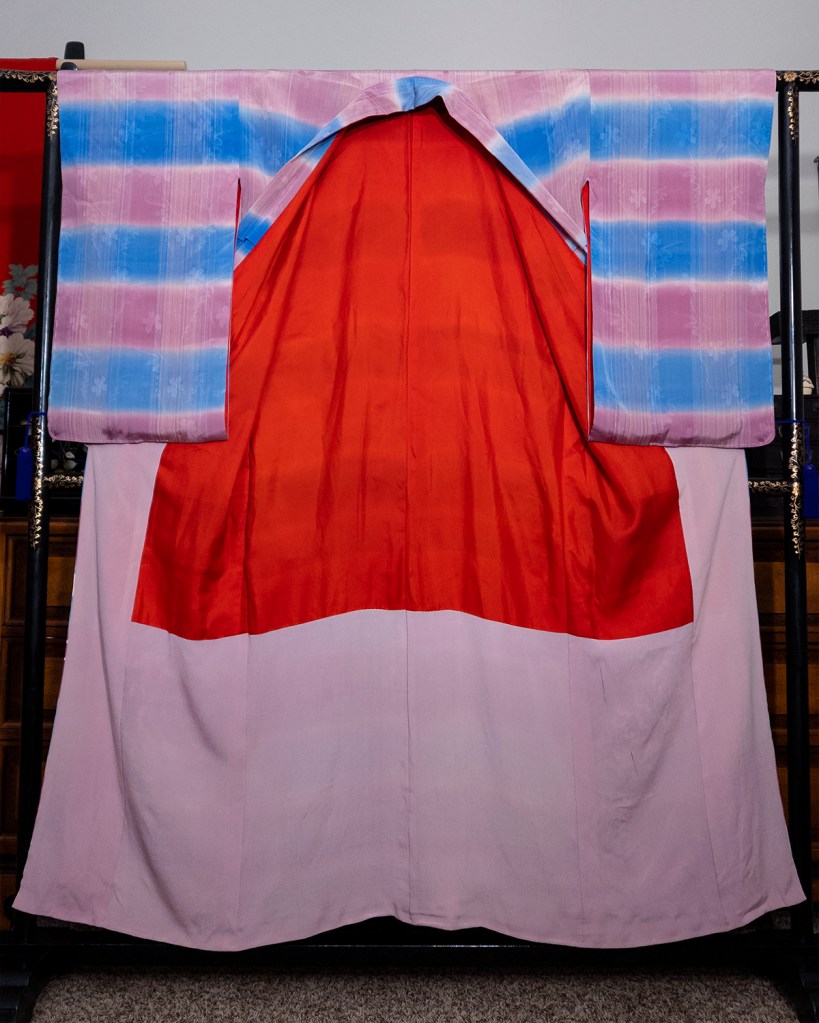

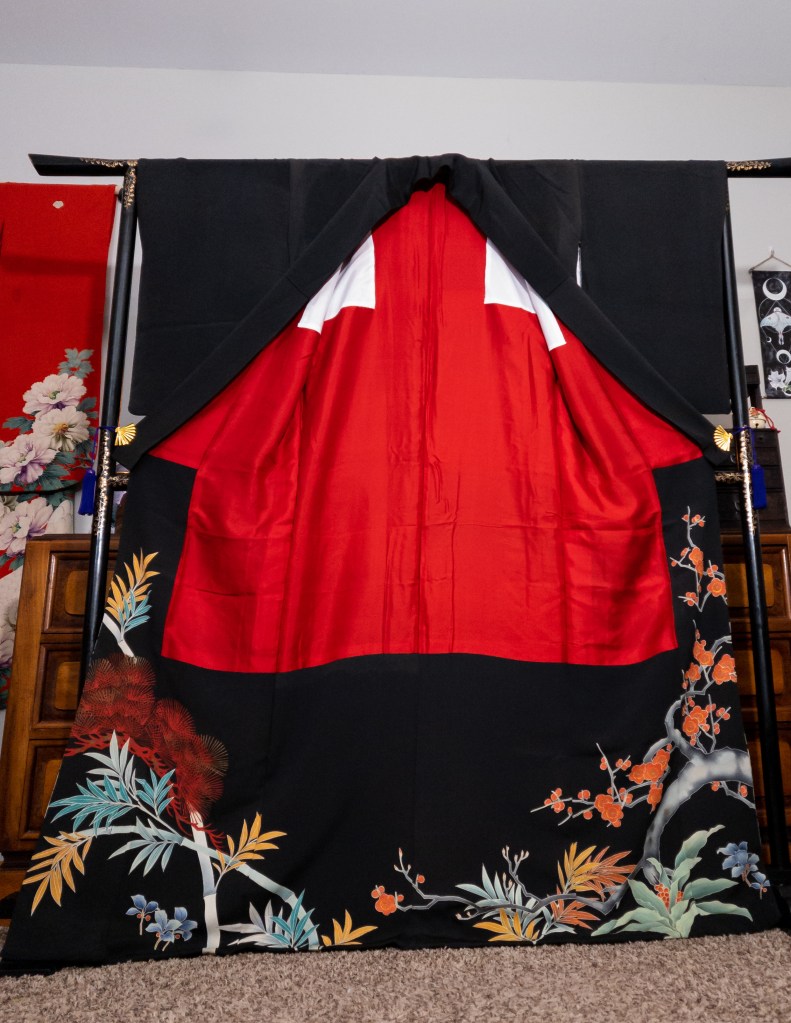
Here are three examples. The first has a full red lining, the second has a red lining only in the sleeves, and the third has a full red lining but is concealed under strips of white fabric. The red lining is called “momi.” Traditionally, it is dyed with the beni flower, but as we get closer to the end of its general usage a synthetic was also used. As a guideline, it’s worth knowing that momi stopped being the default lining installed in kimono starting in the mid-1930’s (early Showa Era), and actually stopped entirely when kimono production shut down temporarily in 1945.
With the exception of stage and wedding kimono (think uchikake), a safe guideline is that if the kimono has a red lining somewhere, it was produced before 1945. Another exception to this is that sometimes you’ll see modern kimono with a strip of red fabric installed at the edges of the armpit holes and the sleeves, and that’s just fashion. To me, this is not something that can easily be mistaken for a pre-WWII kimono.
Note: I’ve heard people say here and there that anyone can install a red lining into a kimono and therefore this guideline should be disregarded. And when I read that, I tend to rub my temples and sigh heavily. Yes, I suppose if we’re being pedantic as fuck, anyone can install momi. I reinstall momi all the goddamn time because, well let’s be honest this probably isn’t your first trip to my blog. You know what I do here. Yes, it can be done. Yes, there are probably a handful of kimono from the 1980’s or some shit out there with old-ass momi sewn into them. But is this happening on a scale that you need to be wary of it for dating purposes? Abso-fucking-lutely not.
And on the flip side of that, anyone who says, “It has a red lining, so it must be Taisho!” deserves a nice whack upside the head with the WRONG stick, too, because decades into both the Meiji before it and the Showa after it are most certainly not Taisho.
So the guideline and not hard rule is that if you’ve got a red lining installed, then your kimono is from 1945 or older.
On the exact other side of that, does your lining look like this?

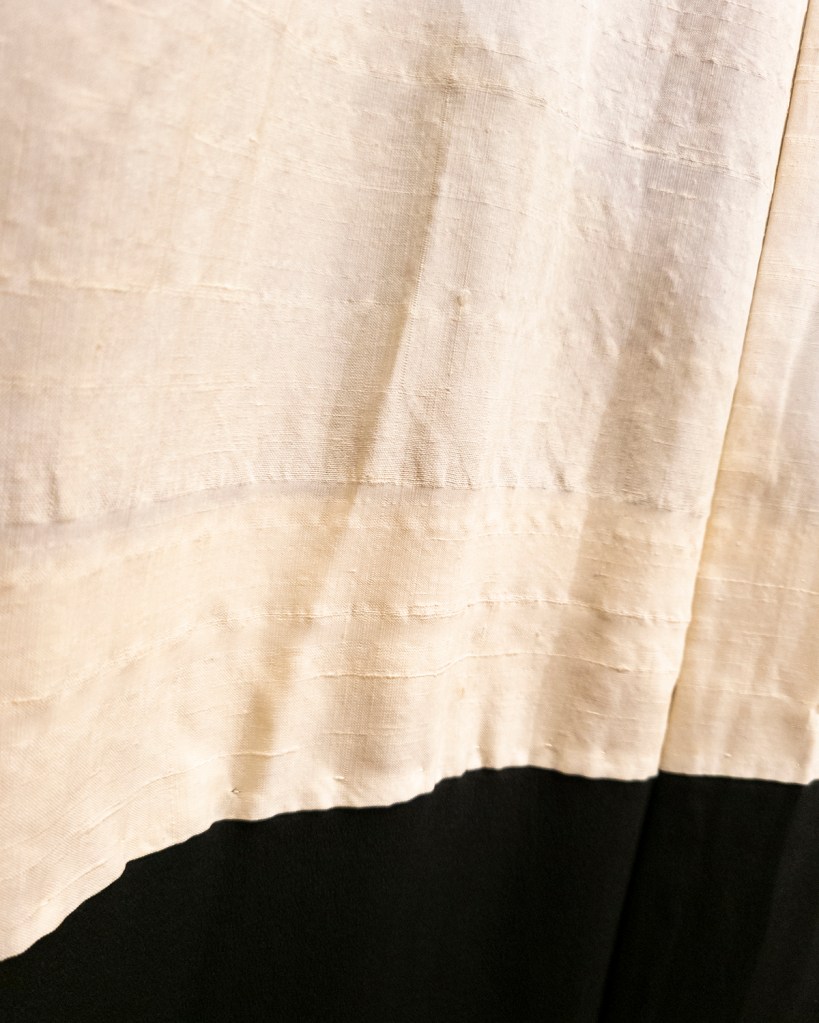


LOL look at that, it’s like a gradient of misery. Despite how they look, nobody was hardcore murdered in those last two kimono. And I can assure you that nobody pissed on them, either…probably. Certainly looks like recycled toilet paper in the end there, doesn’t it? What you’re looking at is the end result of moisture and oxidation of the starching process that was being used between the late 40’s and early 60’s-ish (finding an exact date on this is hell). All four of these linings were once white-ish. Now, it’s worth noting that momi (red linings) were starting to be replaced out for white during the middle to late 1930’s. That puts us in the early Showa Era.
It has been my experience that the closer to pre-WWII the kimono is, the more likely that the white lining is more of a cream rather than a fucking crime scene. What I can deduce from this is that if your lining looks like it was used to move a goddamn body, then that lining was installed sometime in the late 40’s to early 60’s.
The white linings that hover around the 30’s to late 40’s actually tend to just yellow a little bit and that’s all. The hard starching didn’t really seem to catch on en masse until just a touch later.
I will now slap my giant peen on the table and say this: We are a billion fucking times more likely to run into a kimono from the late Meiji to early Taisho Era that has had a creamy-to-crime sceen lining installed later than we are to ever even encounter a kimono from the 70’s with momi installed that isn’t explicitly a stage or wedding piece. Case in point, this motherfucker:
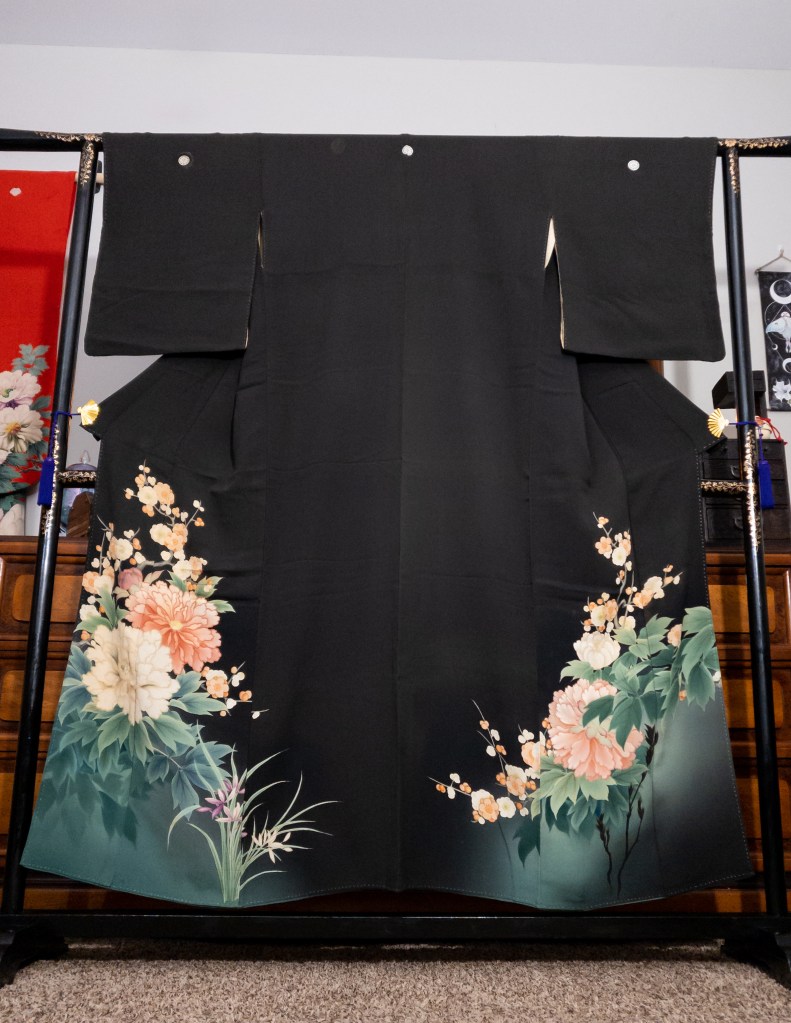

The big. Fucking. Side. Note. Internment Shenanigans Have Entered The Chat: If you purchased your kimono in the United States, you have entered the realm of violence and chaos. These kimono are not beholden the rules of any conventions because any usage or repairs done to them while in internment was subject to extreme isolation conditions. I am speaking in the general subject for this blog entry and not being fully inclusive to internment shenanigans because a) we don’t have that kind of time, and b) quite frankly, I think I might be the only one approaching those pieces the way that I do. So if there’s a set of rules to follow for identifying them, I’m the one who’d be writing them, and I’m not ready to do that yet.
Okay, so we’ve inspected the lining. Let’s move on.
Step 3: Inspecting the artwork.
Now, let’s have a look at the techniques. Let’s inspect our bits. Look for yuzen (resist dyed art), jimon (pattern woven into silk), rinzu (shiny), kinkoma (gold couching), kamon (family crest). Honestly, this is basically: What’s it look like?
Yuzen/dyeing technique:
Starting with yuzen, old yuzen and new yuzen are pretty easy to tell apart if you ask me–and you did, which is why you’re here. Old yuzen is fucking decadent. Especially in the Taisho-ish area, we have dreamy watercolor effects. Take a look at these three.


Now let’s have a look at some newer yuzen. These are from the later Showa and early Heisei Era.
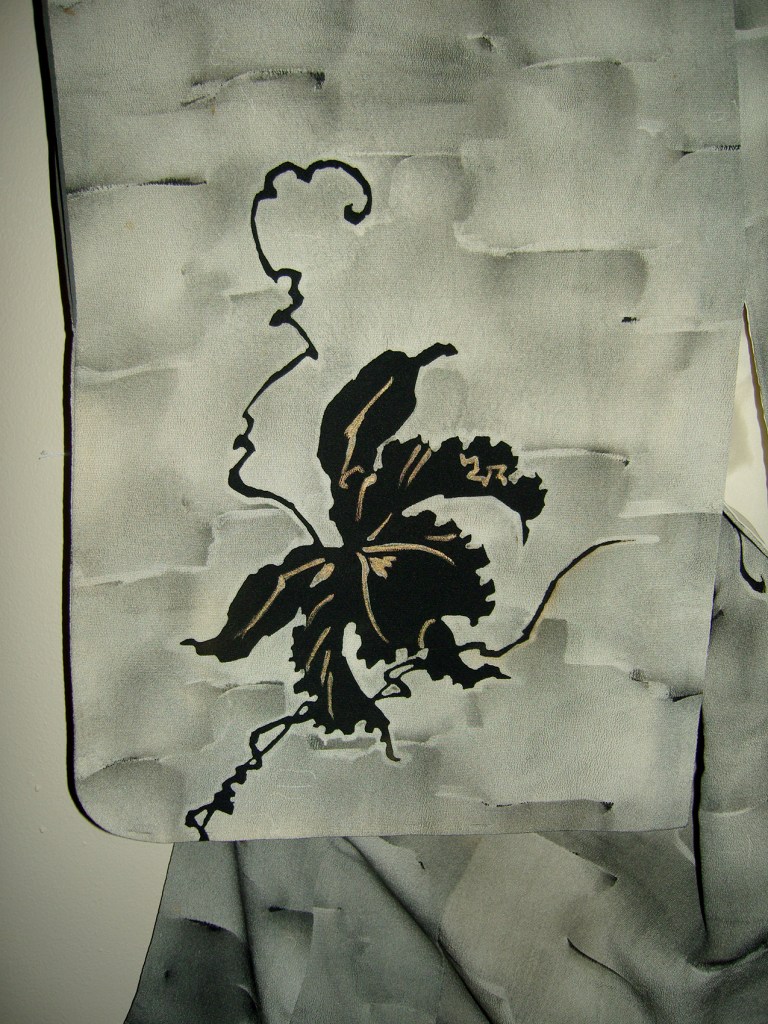

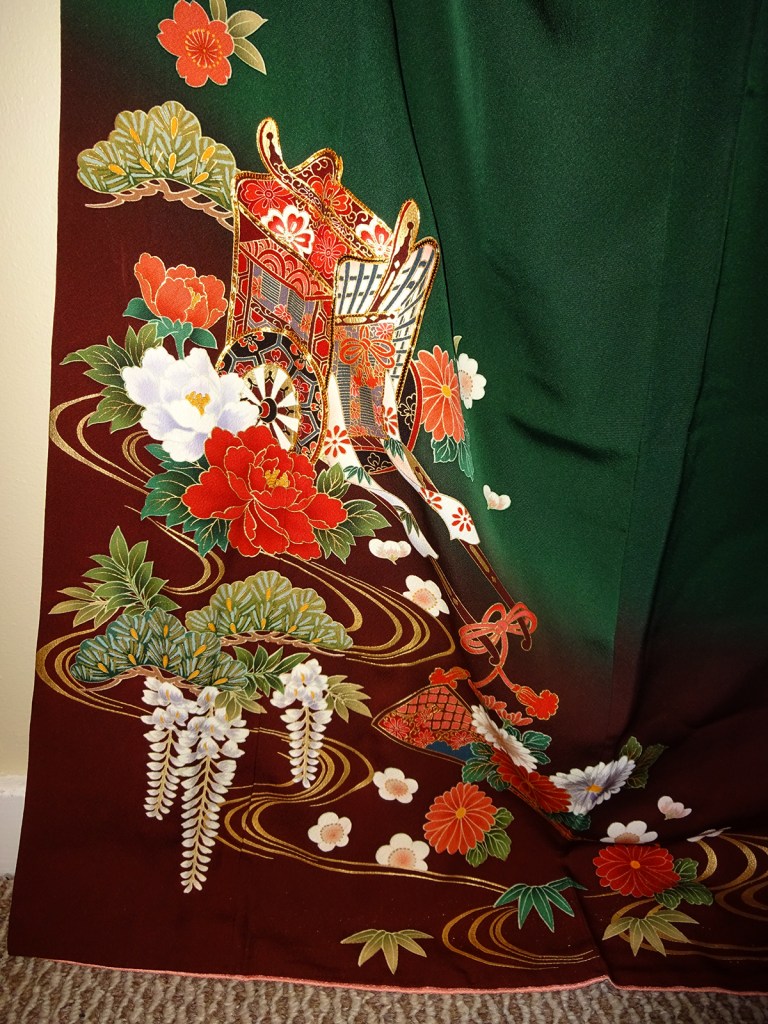
I think a really good word that I like to use for newer kimono is “blocky” and heavily stenciled. And I don’t mean this as a bad thing, by the way. Every kimono you see in this entry is a piece that is in my possession, and I only buy things that interest me. Gradients in antique kimono tend to be softer and have a wider area. I would actually say that starting in the 1930’s we start seeing things that are significantly more heavily stenciled. But this is one of those places where I sat here wobbling from side to side like a fucking metronome for a good solid minute and a half because the idea that they didn’t use stencils since for-fucking-ever is just bullshit.
What I mean is the appearance of being stenciled versus the appearance of being hand drawn. For example, let’s compare these two.


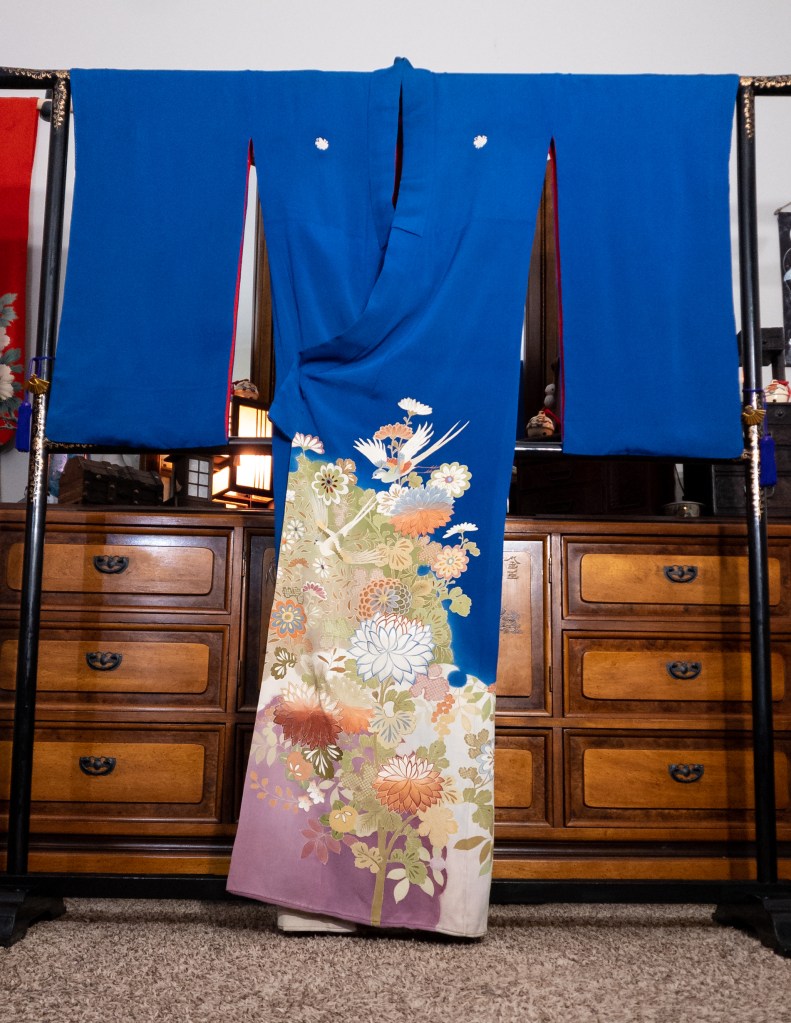
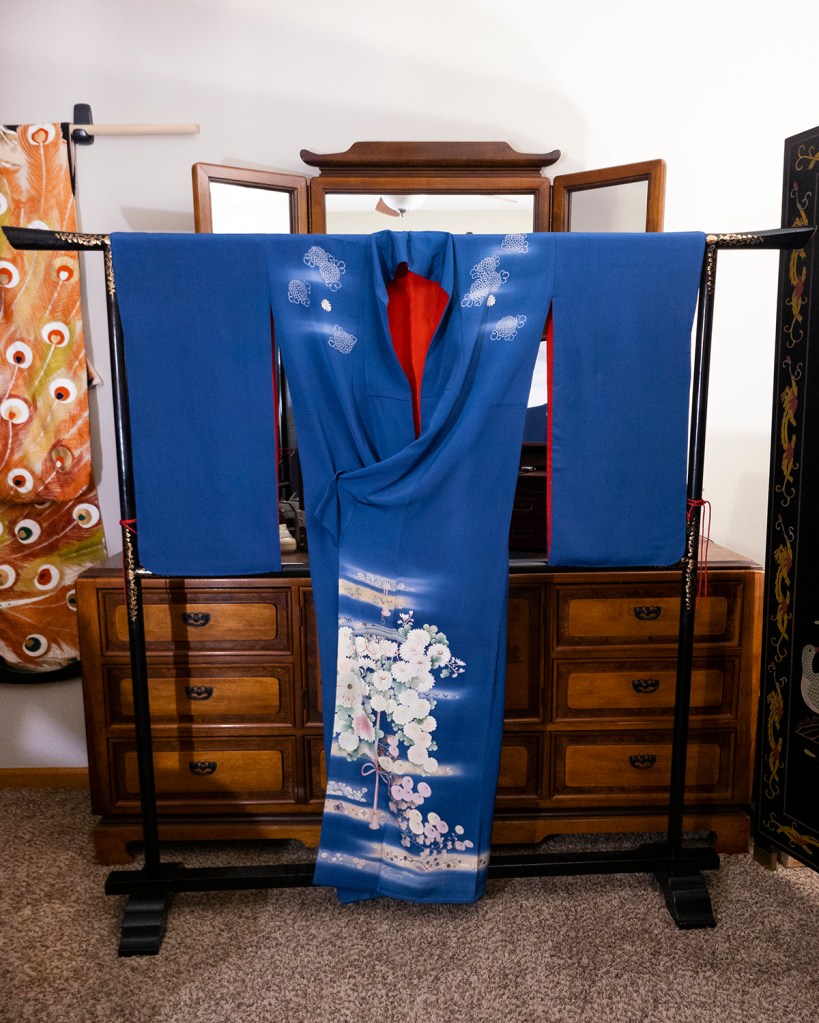
Here we have an irotomesode and kurotomesode, in that order. They both display ryozuma–a mirrored design on the inside and outside of the hem. But if we look nice and close:
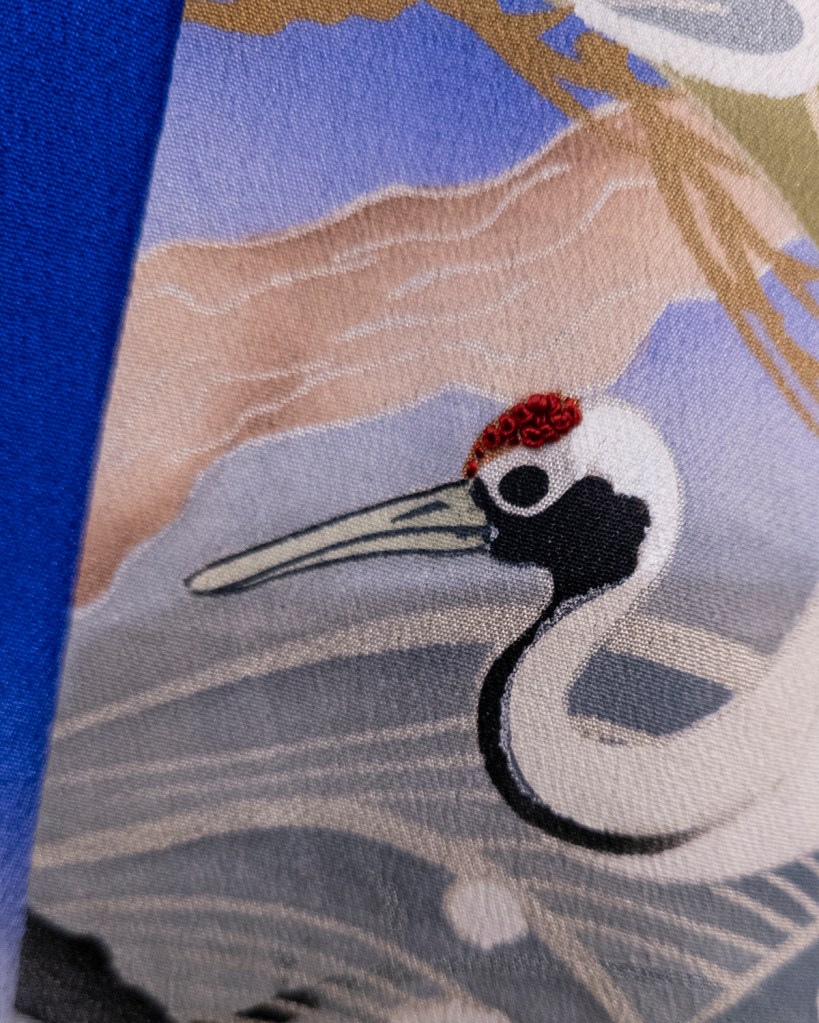

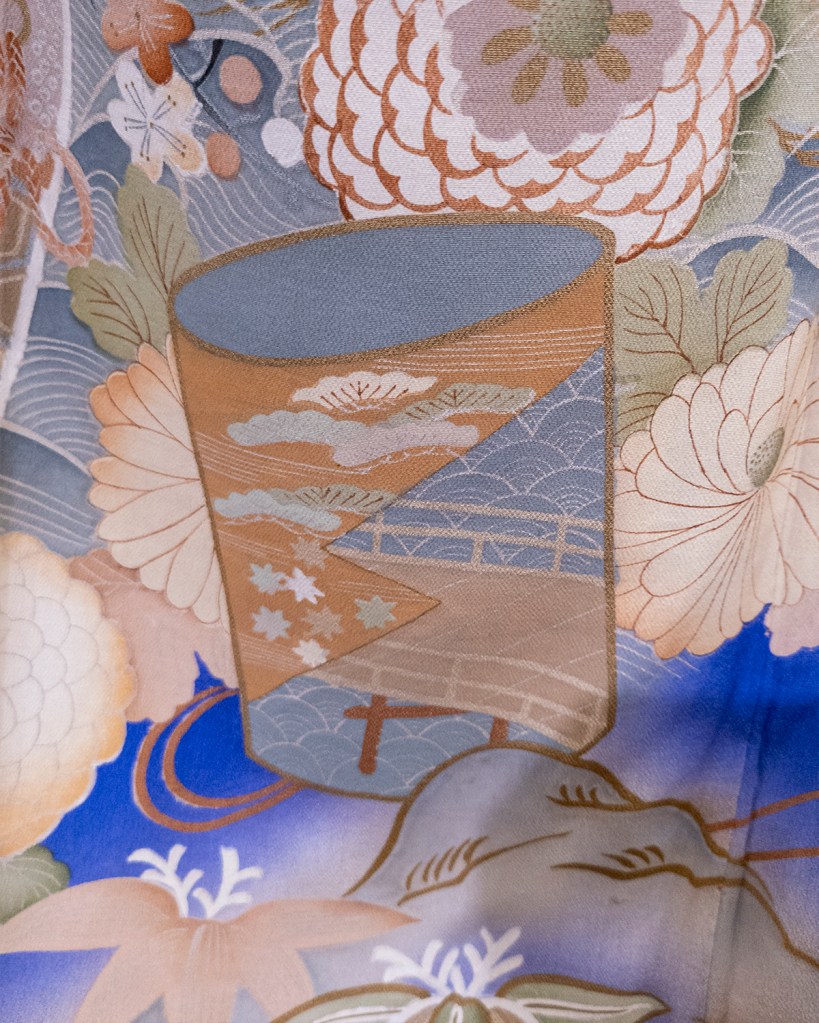
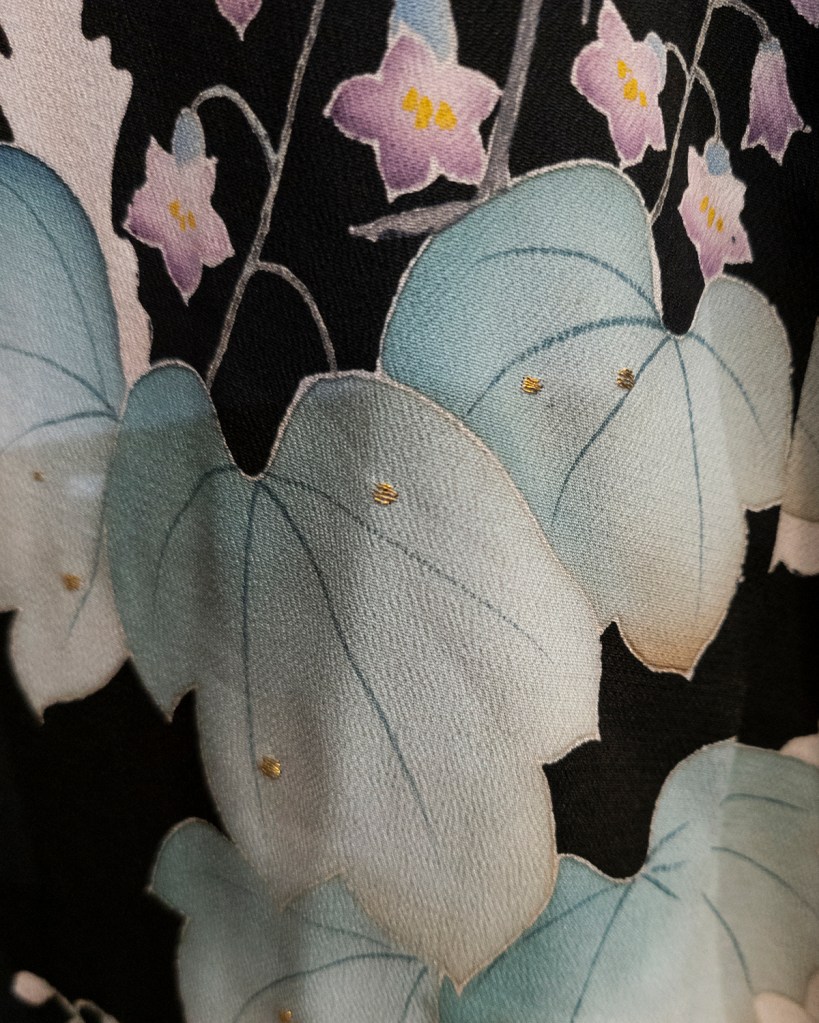

The irotomesode (blue) is from the middle to later 1930’s, and the kurotomesode (black) is from the middle 1920’s. Look at the differences in the excecution of drawing shapes, and shading them. They both display decadent texture and even embroidery accents. They’re both relatively high quality pieces. The blue kimono from the 1930’s has what I call the blocky stenciled look.
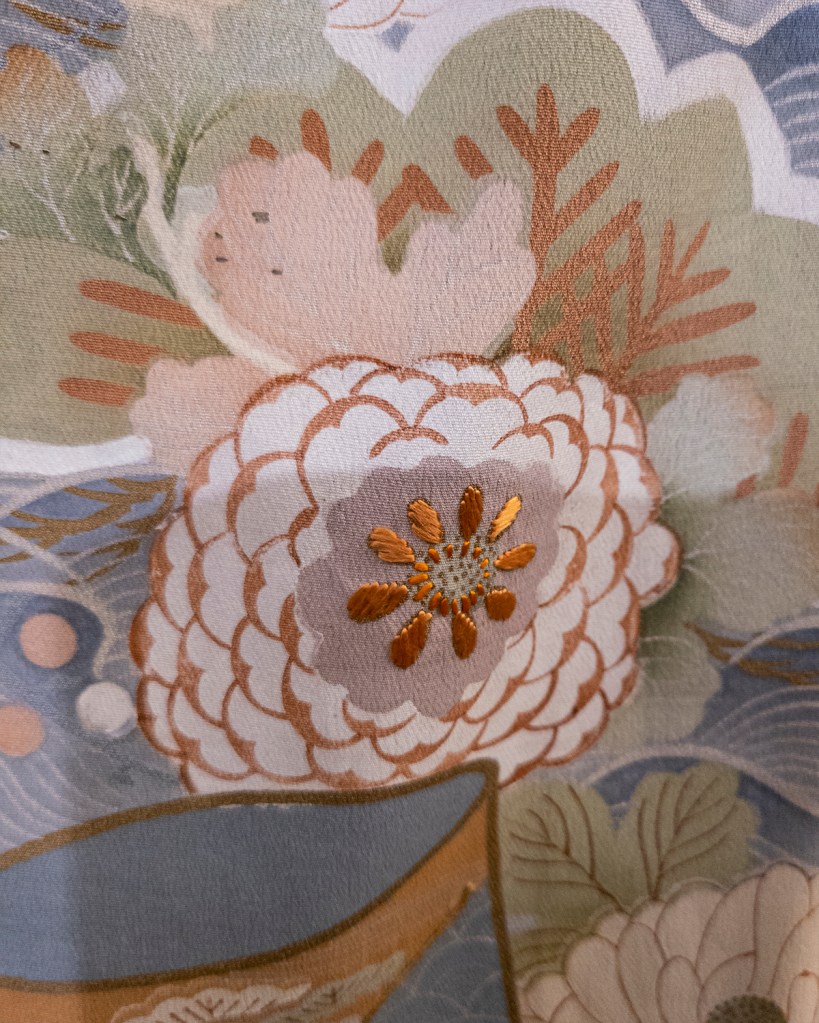
It’s worth pointing out that these are both different styles to begin with. The kurotomesode is kagayuzen, and that employs more resist and brush techniques. But let’s see one that splits the difference:
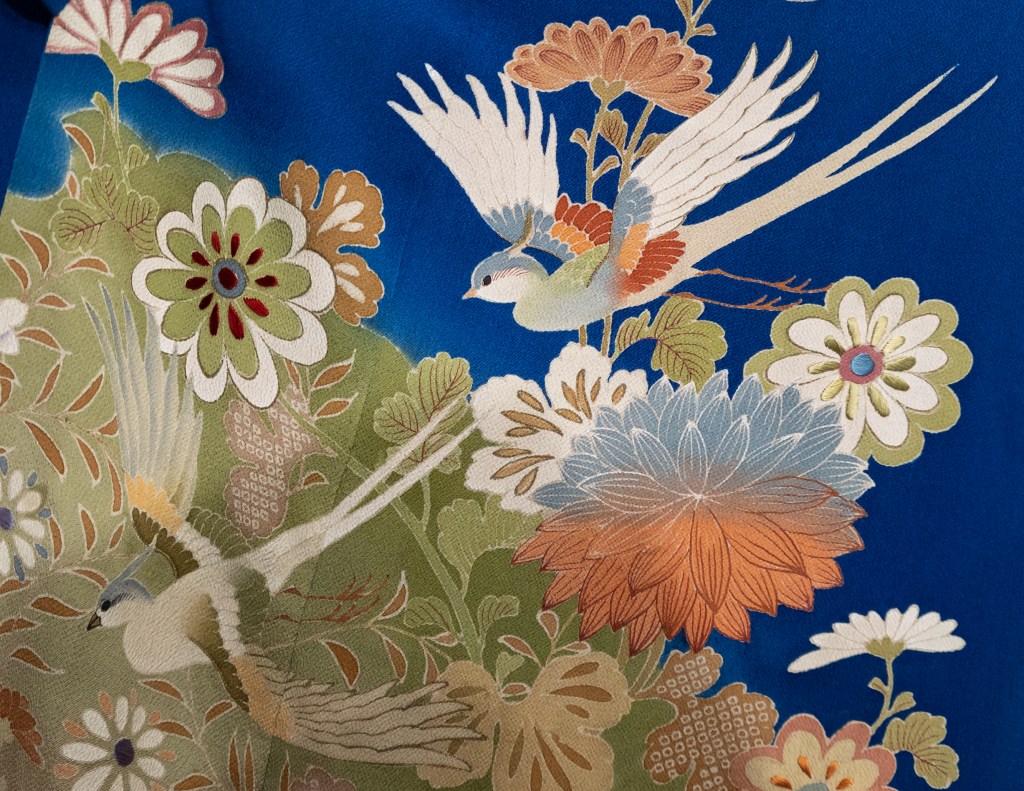
I’d throw that one at late 20’s. And some of the details are most certainly hand painted while large areas and flowers are rather blocky and probably use of stencil dyeing.
My point here is that oftentimes we can see things that are trendy. And sometimes trendy means “affordable.” You know, with that whole war thing going real well at a certain point. But here’s the guideline in a sentence: the tighter, “perfect,” and more blocky or printed a design looks, the newer it tends to be.
Jimon/Rinzu:
Moving on to jimon and rinzu, which are often confused for each other (even by me previously), let’s have a peek at this. Does your kimono have a pattern woven into the silk that is the same color but not the same texture or lustre as the rest of the silk?

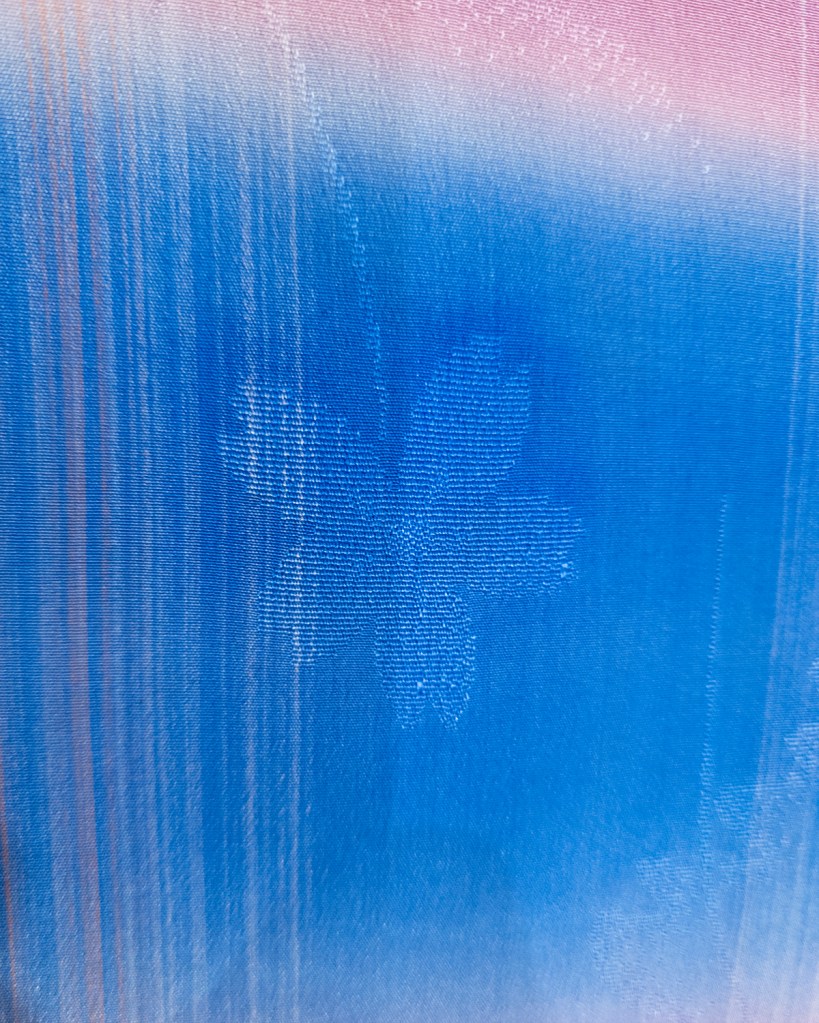
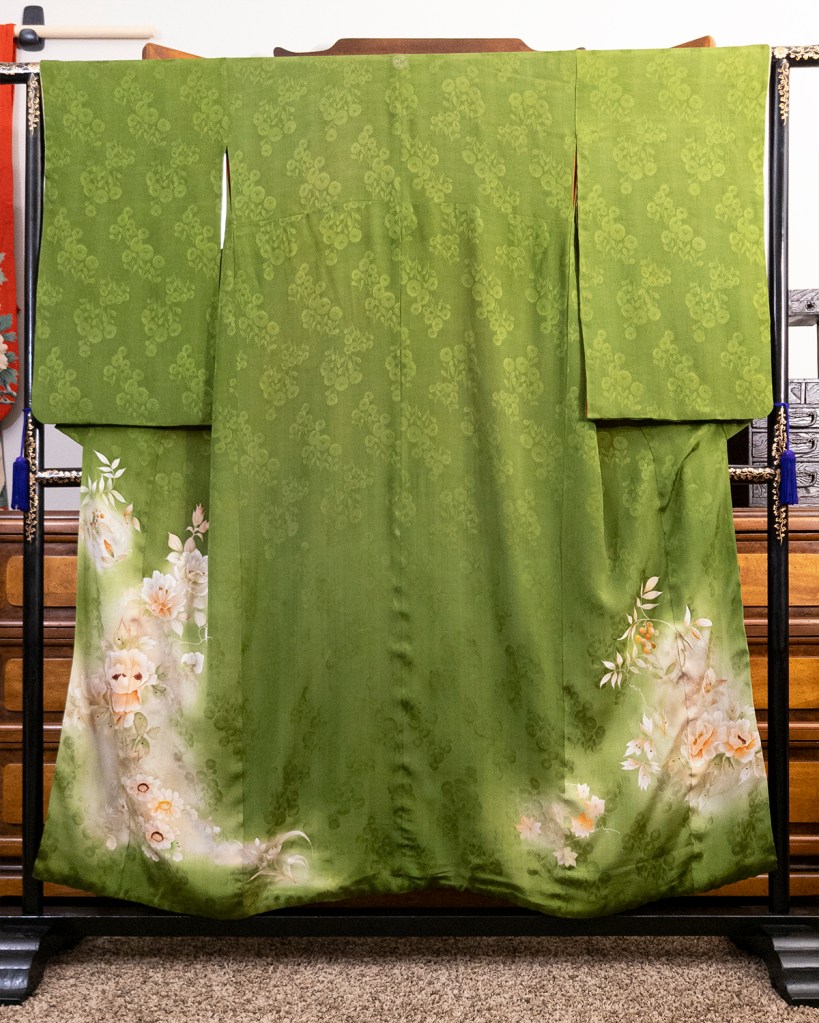


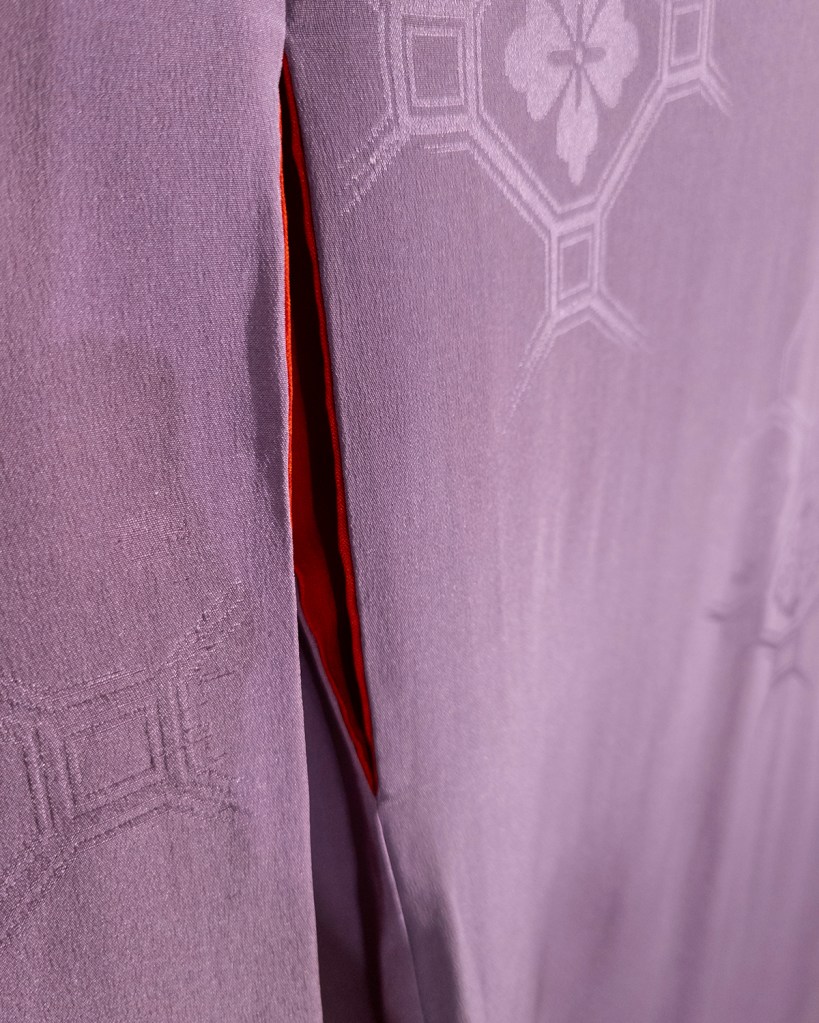
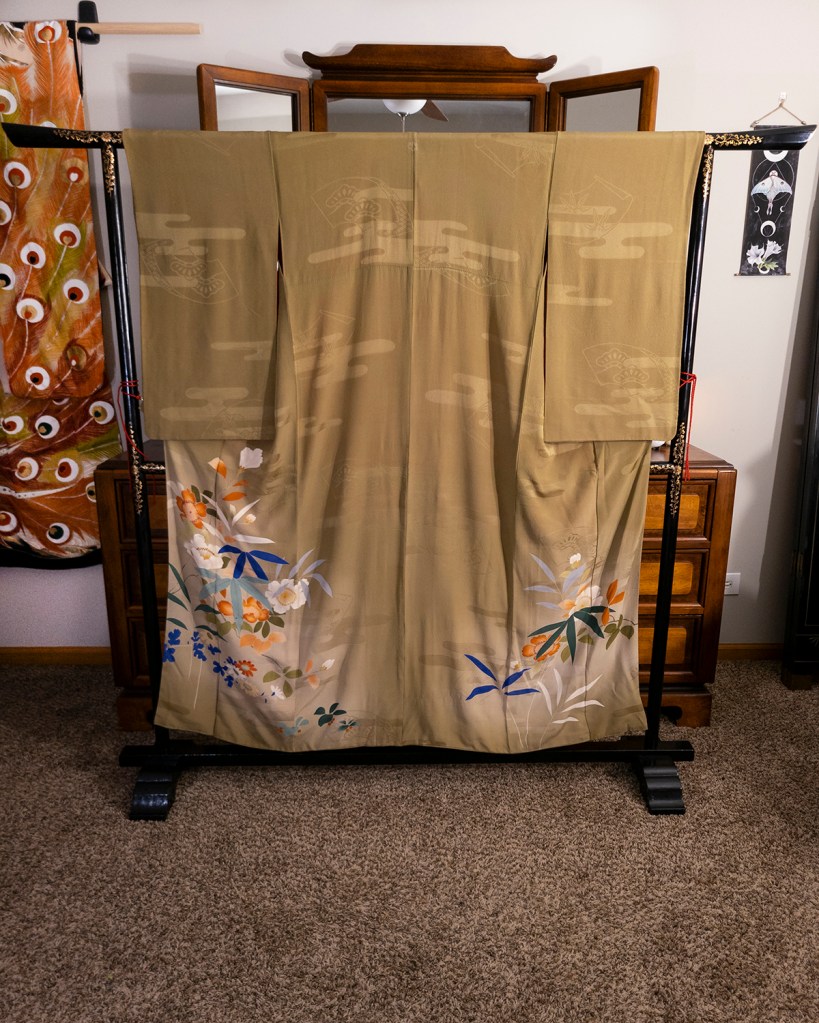


These are all late 1920’s at their oldest. Let’s have a good solid look at these textures. Get all up in their business. We are texture stalking now, and there are no orders of protection that can stop us. Notice the delicateness of the fabric. Notice how the shapes often have softer edges to them. Let’s compare this jimon to more modern type, this one being into the 50’s.
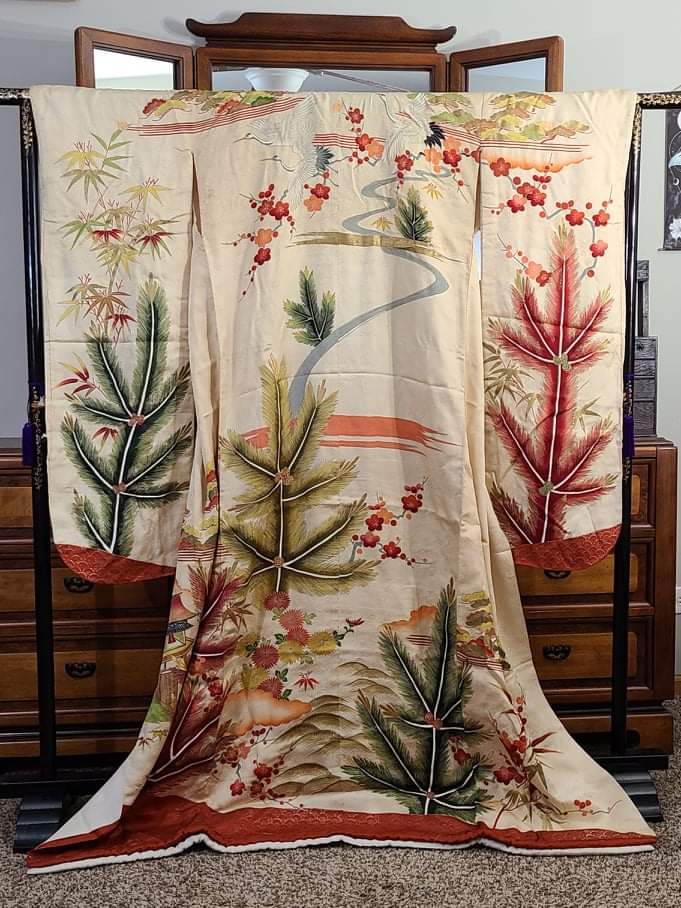
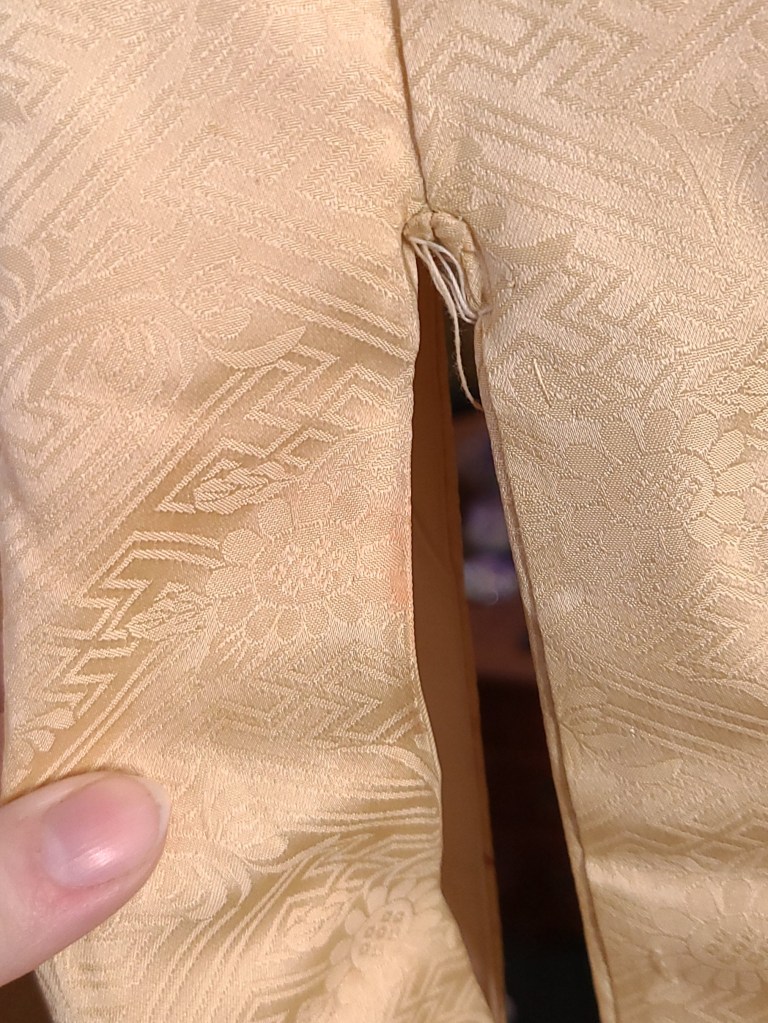
Look how tight and rigid those shapes are. So the guideline here is to look for lighter, thinner, delicate, and more loosely woven patterns. Basically, does it look like it was done by hand? And another thing that I don’t have a great example of at this time: if there’s jimon on your kurotomesode, it’s probably old as hell an antique.
Kinkoma/Kinsai:
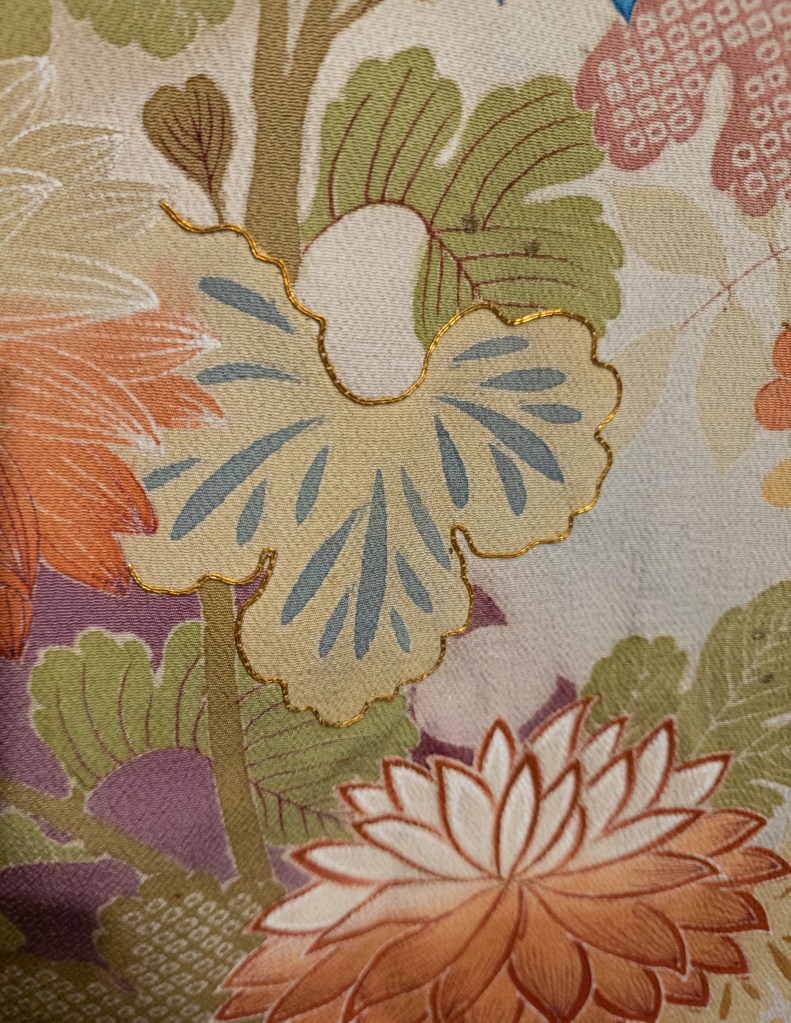
Moving on to kinkoma and kinsai. This one is really goddamn easy. Basically, antique kinkoma (gold couching) and kinsai (gold paint) tends to be small and very delicate. The newer ones tend to be chonk as fuck. Let’s have a look. Here’s some fucking old kinkoma.


And here’s some fairly new ones.


In reality, couching threads vary wildly, but in my handling experience, pre-WWII kimono have smaller and more delicate threads than newer ones. Probably I would comfortably say starting in the 1960’s, we start seeing some CHONK ASS couching threads on the reg whenever we see couching.
And then we have kinsai and ginsai. It has been my experience, starting in the 70’s-ish, that they started applying kinsai that is super textured. Basically, it really sits on top of the material, and it’s bumpy. You can almost imagine it being applied the same way they frost a goddamn wedding cake, and I think that’s actually closer to the truth than I wanted it to be. It almost reminds me of stained glass window solder. Older kinsai, on the other hand, tends to sit flat on the surface of the silk.
Kamon:
Moving on! Does your kimono have any kamon on it? Are they freakishly large or wildly decorated?

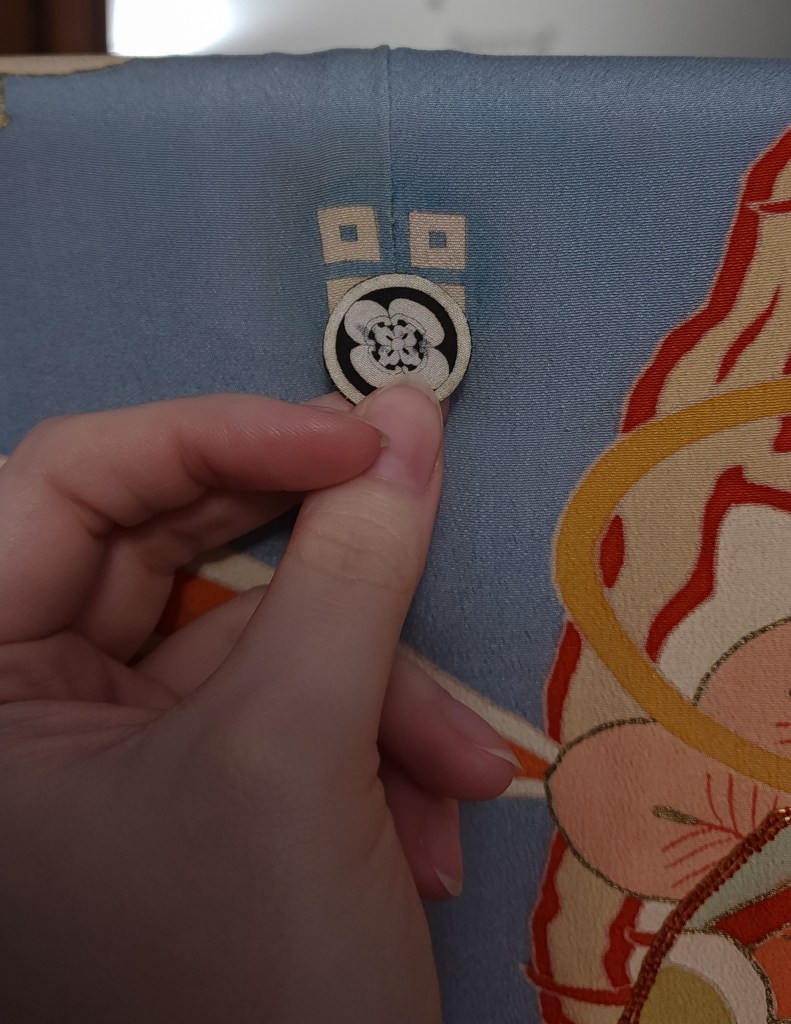
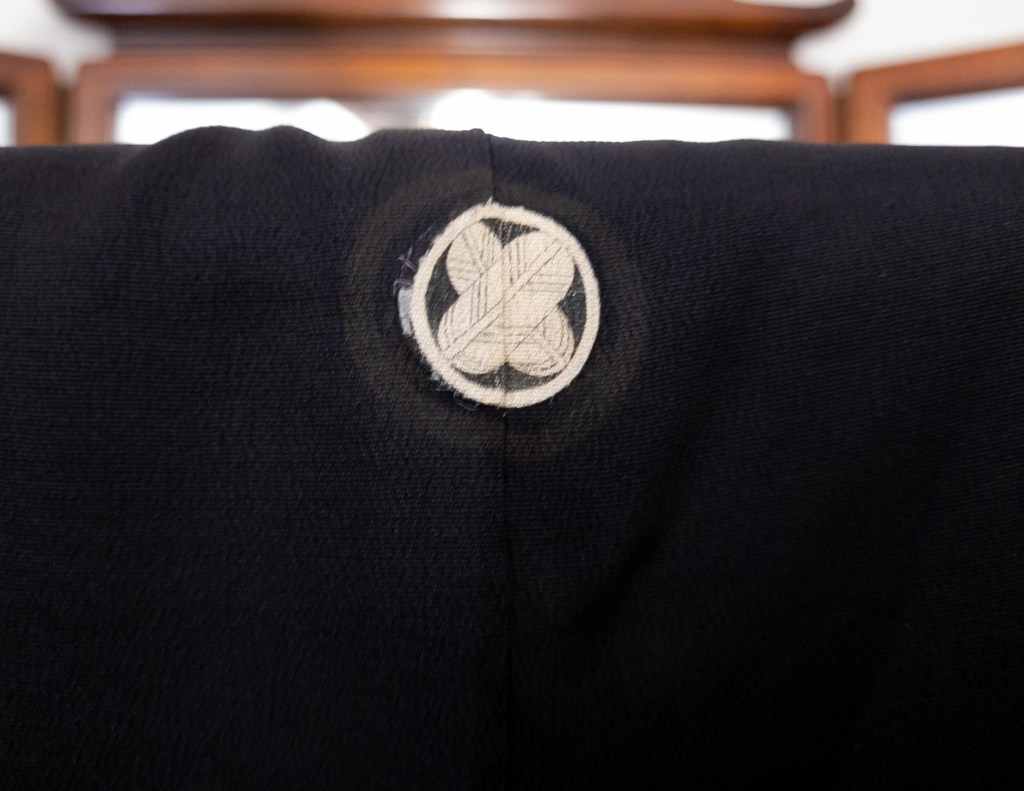
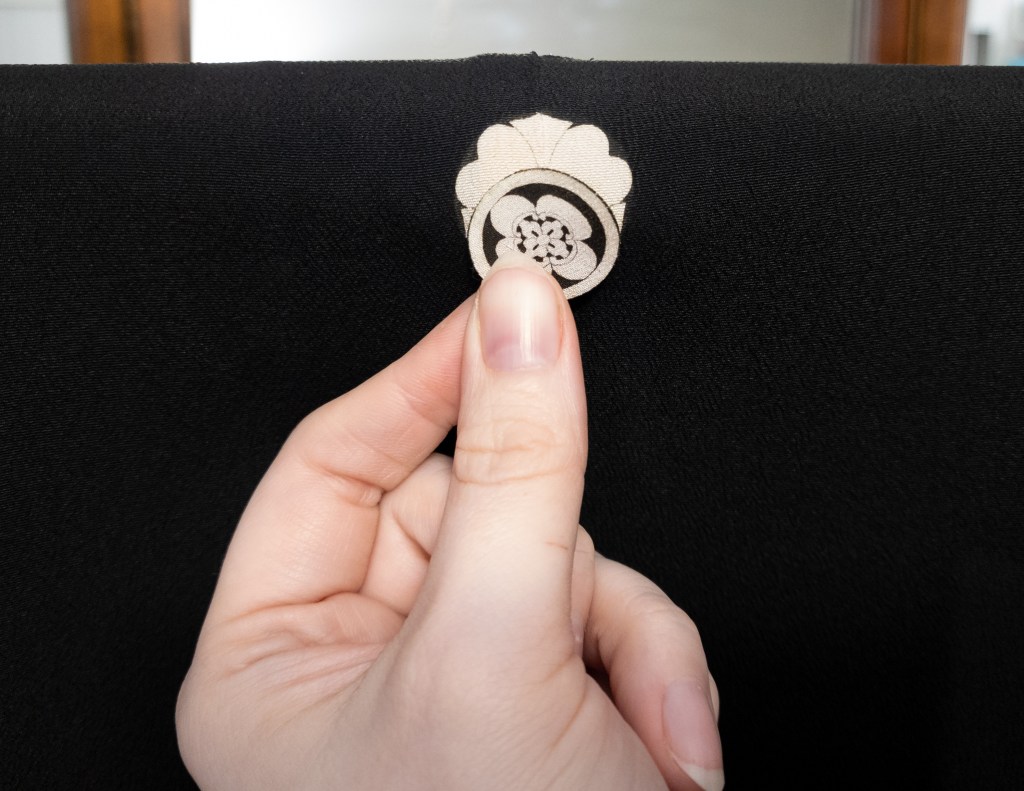


This one is pretty self explanatory. As a guideline–and not a rule–older kimono tend to have larger kamon. What’s actually kind of funny because as I covered in my Kurotomesode Brutality post, there were plenty of occasions where they would black out the old kamon and attach a new kamon applique. Sometimes the old mon was so much larger than the new one that as the dye settles you can literally see the halo of it, and I’ma be real with you, I laugh every time I see it. The little applique I’m using in the picitures is a standard modern kamon size. I want to say that big-ass honkin’ kamon leans hard pre-WWII. So I did. There it is.
And finally, are you struggling with all of your might to put your kimono in a contemporary formality category and coming up blank?


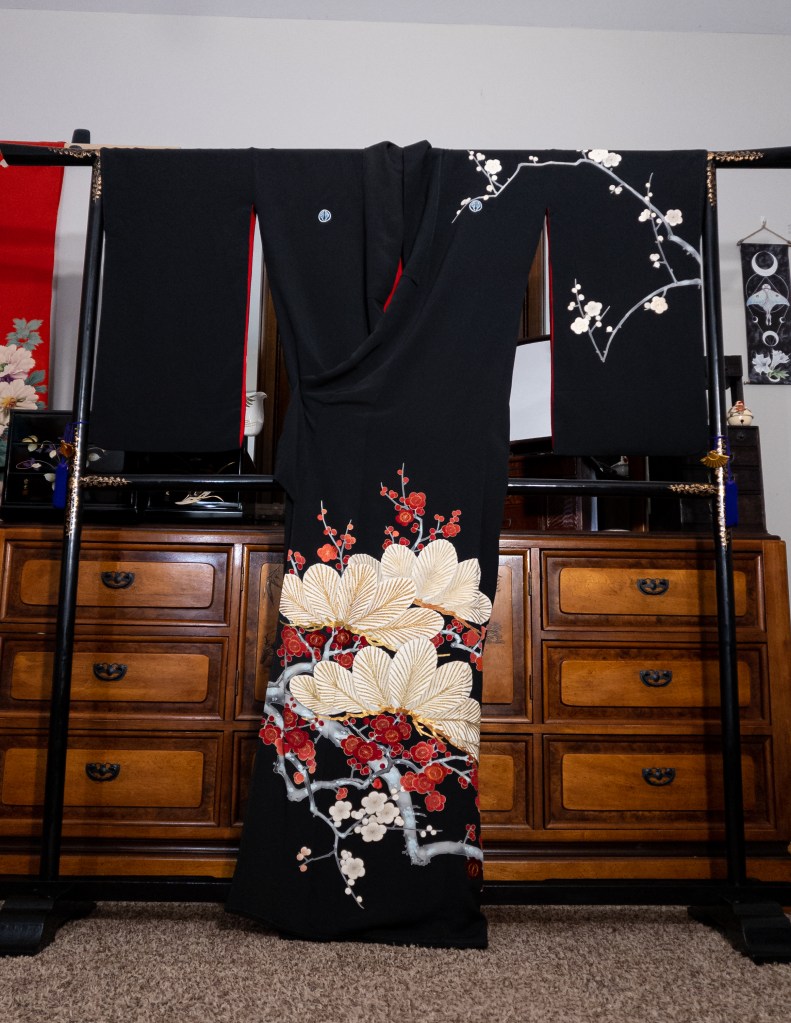


Then chances are it’s pretty damn old. Words like “sanpogi” (literally “walking kimono”) and “eba-suso-moyou kuromontsuki” are words that should join your kimono vocabulary. Speaking of exactly that, I’m working on a glossary by popular demand. Kill me. Anyway, that’s what I’ll be covering in part 2; the antiques that don’t make contemporary sense and the why’s and how’s behind them.
How many parts will there be to this? Well as I get into it, I’ve decided it’ll be as many as it takes. Because, as it turns out, I can look at little things and just go YEAH, but when I actually start listing them, that list gets really long really fast. So join me next time when I start listing more shit! I’ll still be peppering other little entries in here and there, too. Down time is less fun when you snort kimono instead of drugs.
BYE.

 Silk & Bones
THIS IS THE BEST!!!!
I’m so happy this series is happening, thank you for all your hard work🖤. The massive Kamon are indeed hilarious. I myself own a few pieces where the lining looks like somebody was embalmed in it (nagajuban to be specific, which is a bit gross). I assumed it was mold but I know now why haha.
LikeLiked by 1 person
… Do you accept offerings? Cause damn. At this point I’m not above some freestyle worshipping. This is extremely helpful in confirming my observations over the years!
LikeLiked by 1 person
LOL Thanks! I’m working on a part two!
LikeLiked by 1 person
Allow me to shower you with daifuku. And I don’t share my daifuku with anyone :))))))
LikeLike
Thank you so much for all the information, but also for writing it in a way that keeps my neurospicy brain f*cking dopamined.
LikeLiked by 1 person
Happy to serve! 🫡
LikeLike
Potty mouth, my eyes are killing me with visuals of the F word. I’ll be dreaming about the F word tonight. Someone should educate the writer on how to be explicit without profanity. Please find who wrote the article and wash their mouth out with soap!
LikeLike
I don’t walk into your house and tell you how you can speak.
My blog is 100% free. No ads, no store, no sponsors. I pay EXTRA to keep it free, and I will talk about things however the actual fuck I want.
If you don’t like it, you’re welcome to leave and not come back.
LikeLike
I loved this fucking treatise. My grandmother left me a kimono with very little background story other than the classic “great uncle got it in the war” story. Now I’m wondering if I could pull of a restoration/cleaning myself. It’s not as colorful as the ones you have featured here; those are stellar.
LikeLike
This was so incredibly helpful! I just took a trip to Japan and happened upon a box at a thrift store full of kimono for hundred yen apiece. That was the beginning of the end as I went later to three secondhand kimono stores collecting accessories and then more kimono and then of course more accessories…Needless to say, I now have a small collection and am desperately trying to figure out how old some of these pieces are. Can’t wait for part two, and in the meantime I’m going to consume the rest of your blog and learn as much as I can.Someday I may even be able to tie an obi by myself!
LikeLiked by 1 person
what a treat to have found your blog, and your collection is beautiful. Your knowledge is mind blowing to a novice like me . I rescued a kimono while thrifting . Has stains 🥲. I still can’t really figure out the date because the silk is woven but it’s all hands sewn , and it has the red lining but I am still not sure . The red lining does not feel like silk . Anyway I am in the process of removing the bottom half of the pink silk lining so I can wash the stained parts separately . Hopefully with luck , I don’t fuck up.
When you mentioned history of interment Kimono’s, it was a startling fact that many don’t consider . I will keep your blog as my favorite . regards
Reneé
LikeLike
This is so helpful, thank you for writing this! I can’t wait for a part two!
LikeLike